
New Tool to Locate Least-Reached Peoples in Least-Reached Areas
The Diaspora Missions Collective is a Southern Baptist partnership between the North American Mission Board, Women’s Missionary Union, International Mission Board, and Send Relief with the purpose of assisting churches to reach the diasporic groups living in the United States.
For years, I have written about the limited research related to the unreached people groups who have migrated to this country. The Church has better information on a people group living in a remote location of the Himalayans than she does of that same people living in the United States. When I published Strangers Next Doorin 2012, the United States was home to the third largest number of unreached peoples, behind India and China. This fact remains at 210 unreached people groups today (including 70 unengaged unreached). Research has improved very little since that publication.
After Brent Waldrep, diaspora research strategist with the IMB, heard of my research on the least-reached locations in this country, we began discussing how such findings could overlap with the present data on the foreign-born populations residing here.
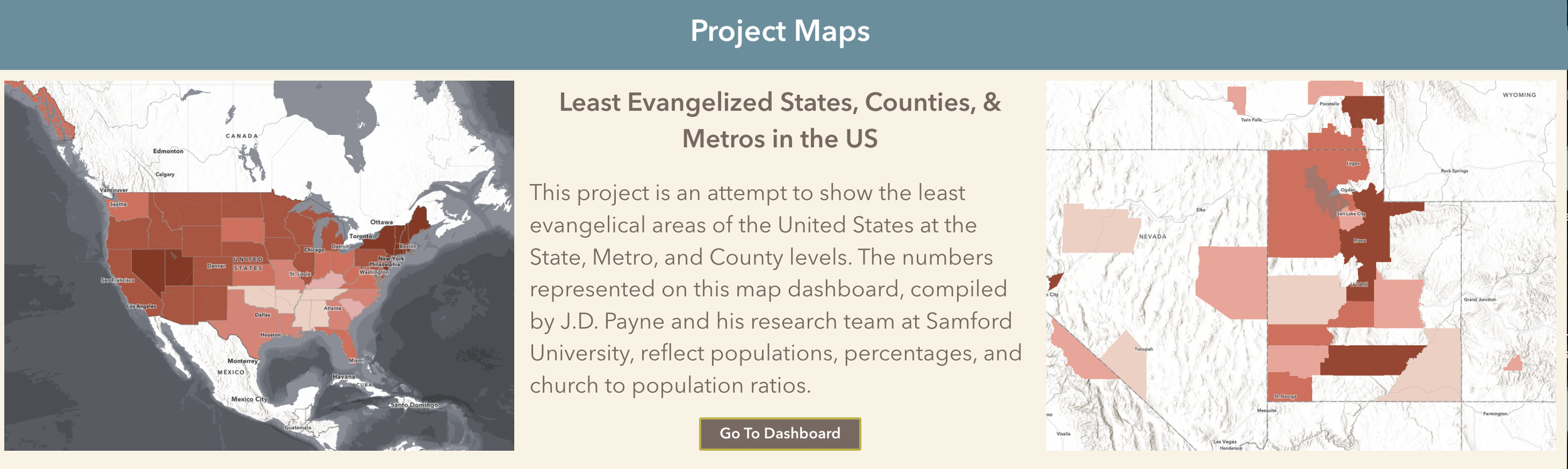
The result is Brent and his team produced an amazing, interactive, on-line, map to assist churches with their engagement of unreached people groups. The question behind this resource is: “Where are the least-reached areas of the United States and who are the people groups living there?”
Until last week, no tool was available which provided this information. Now, we have the ability to develop church multiplication strategies that focus on the least-reached people living in the least-reached areas.
However, this resource has limitations. The foreign-born population is based on the government’s research. The United States does not inquire about people group data but asks individuals the names of their counties of birth.
For example, 205 people groups live in Mexico. While 5 of these are unengaged and unreached and 29 are engaged but unreached, our government only labels those living here from our Southern neighbor as people from Mexico. Another limitation is the foreign-born population in the US is underrepresented. People are not always transparent when asked about their countries of birth. Also, the data does not provide details on second and third generations living here.
Researchers are needed in these communities to develop our people group understanding.
Inferences are our friends. For example, if we use peoplegroups.org or joshuaproject.net and find a particular country has a large representation of unreached peoples in its population, and a US location has a number of people from that country living there, then it is very possible those who migrated to the US represent an unreached people.
I live in Alabama where it is believed college football is the only sport in the universe. To use a metaphor inspired by my state, this new resource has the potential to help the Church move the ball further down the field toward the goal line.
Will this tool be used to develop prayerfully discerned, Spirit-led strategies, or will churches, denominations, and networks continue with random approaches to church planting based on convenience, hunches, and speculation?
It’s game day. The 5 billion remain.