
Diffusion of…Churches?
Why are unreached people groups defined by a statistic? Why do strategists speak of evangelical church to population ratios? These are the questions addressed in this post. I also will show their relevance to the US Evangelical study released several days ago.
Presently, the unreached people group number rests at ≤2% Evangelical (with Joshua Project including ≤5% Christian adherent). Prior to this value, the statistic was around 10%. And in the 1970s, and early 80s, 20% was the marker. But to answer the question, and to get to the church to population question, we must turn to the 19th century with to the work of a French sociologist and criminologist and the concept of innovation.
Diffusion of Innovation
Diffusion of innovation theory traces its origins to the work of Gabriel Tarde (1843-1904). Tarde searched for a meta-theory on cultural change. His research lead him to conclude that some people are leaders who guide others and some people imitate others. If innovations are too complex or too simple for society an innovation does not spread. He advocated the S-shaped diffusion curve. We often refer to this as a growth curve, which may be found in various growth strategy books. Aubrey Malphurs popularized this curve among evangelicals in his work on strategy.
Bryce Ryan and Neal Gross built upon Tarde’s work in the 1940s. Their article, “The Diffusion of Hybrid Seed Corn in Two Iowa Communities,” (Rural Sociology 8, pg. 15-24) took diffusion of innovation studies to a new level. They also agreed the adoption of an innovation in a community followed an S-shaped (sigmoid) curve. People differed in the speed of embracing change. Those first to accept an innovation required the leadership and influence from those outside their community. Those who embraced the innovation later in time did so through the influence of those within their community.
Through the work of Everett M. Rogers, the diffusion of innovation concept spread. His book Diffusion of Innovation is in its 5th edition at the time of this writing. His work established the concept of “early adopters” and showed how macro-level structural changes in society are linked to micro-level (individuals and groups) processes. Malcolm Gladwell would remove the academic aspects and take the matter to the masses with The Tipping Point: How Little Things Can Make a Big Difference.
Evangelicals Pay Attention
In 1968, demographer and statistician, David Barrett was the first to apply a percentage to a people to note a shift in their identity as Christians. Though there is uncertainty as to why this statistic was 20% (I suspect it was the influence of the diffusion of innovation and Barrett’s own research.), Barrett did not initially use it to define reached and unreached (Dave Datema, “Defining ‘Unreached’: A Short History). Years later, he noted in his 1982 World Christian Encyclopedia, “the only people groups who can correctly be called unreached are the one thousand or so whose populations are each less than 20% evangelized” (19).
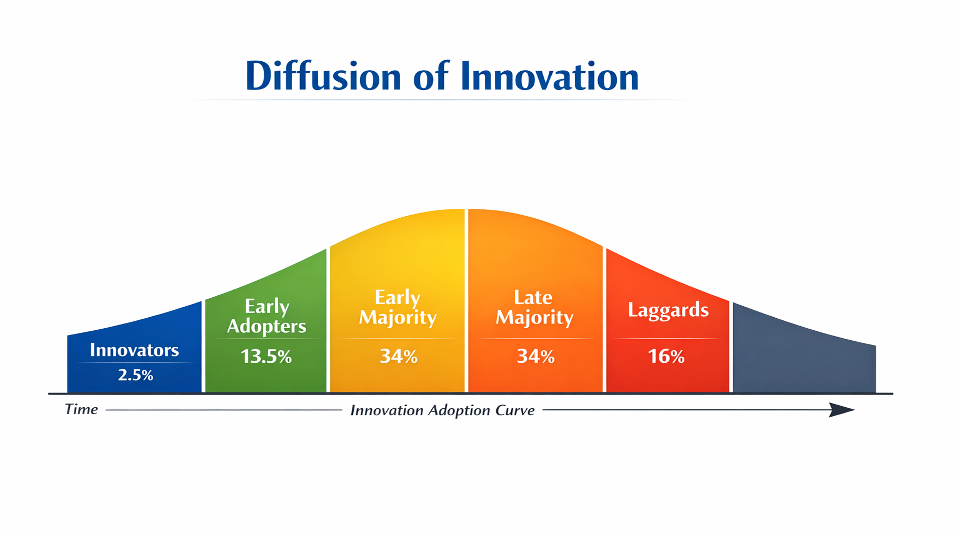
Mission strategists (e.g., Ralph Winter, C. Peter Wagner, Edward Dayton, Lausanne Strategy Working Group) found the 20% statistic to be impractical when applied to populations in countries. At the time, such would mean a incredibly large portion of the world would be labeled unreached. For example, both traditionally Western countries and remote central Asian contexts would be seen with equal priority. However, from the diffusion of innovation perspective, if the percent could be around 10%, (or 10-20%) then that would include the innovators (2.5%) and a portion of the early adopters (13.5%) found on the bell curve. Missionaries from outside the population would be able to influence this portion and then phase-out while the 10% of insiders would run with the gospel throughout the community. Over time, however, those serving among resistant soils (e.g., the Muslim world), found 10% to be too lofty of a strategic goal and demoralizing. Their voices were heard, and the definition shifted again to:
2%.
Returning to the innovation bell curve, if the innovators could be reached with a new concept, then they as insiders, could disseminate the novelty throughout their people group.
And what is the percentage of innovators within a society?
2.5%.
Matter of Kingdom Stewardship
The Spirit is not limited by statistics. Yet, if all truth is God’s truth wherever it may be found, then the diffusion of innovation is something wise Kingdom stewards must consider in view of the five billion who have no relationship with Jesus.
When John Mark Terry and I wrote Developing a Strategy for Missions, we advocated 10% as an ideal goal for strategy development. If such is embraced, then this statistic not only has implications for people groups, but also implications for church multiplication among any population.
Jim Montgomery was an early advocate who considered church to population ratios. In his 1989 book, DAWN 2000: 7 Million Churches to Go, Montgomery came to the following church planting goals for believers to Disciple A Whole Nation (hence, DAWN in the book’s title):
“When the Church of every country has an intentional plan for saturating its land with cells of believers—one for every 400 to 600 in rural villages and one for every 1,000 to 1,500 in its cities distributed among all the cultural, ethnolinguistic and societal groupings of the land—we will be in high gear for completing the Great Commission in our time.”
Church to Population Ratios
An easier way to understand these numbers, while taking the diffusion of innovation into consideration, is one evangelical church for every 500 people in a rural area and one evangelical church for every 1000 people in an urban area. If that rural church is comprised of 50 believers and that urban church consists of 100 believers, then the communities have reached the 10% threshold—ideally including the innovators and a portion of the earlier adopters.
US and Low Ratios
This is a portion of the missiology behind the evangelical concentration study I recently released. If you have not had a chance to check it out, you may find it posted HERE from March 17.
Many of you have interacted with the free, on-line map and noticed for each state, county, and metro location, there is an evangelical church to population ratio. These statistics should be taken in consideration with the ideal strategic goal of 1:500 and 1:1000. There are places within this country that meet these numbers or exceed them. However, as you have likely noticed, there are numerous locations that have low ratios and in need of numerous evangelical churches.
And this is within the United States, home to 350,000 churches.
The greatest needs for disciple making and church multiplication are outside this country. Imagine the ratios there.
The 5 billion remain.