
Two Earthshaking Conclusions about AI

image credit: pixabay
“I hope you will not try to get us hayseeds into more trouble by urging the use of the auto. We want something we can raise ourselves, and also the feed that keeps it going. Like the bicycle, they are a fad, and, like many another, will go out” (Pacific Rural Press, October 3, 1908)
Technology and innovation bring change—frequently the change that makes us uncomfortable. I rode a horse once. It was a novel experience for me. When it was over, I was thankful to then ride 228 horses (with a 2.4-liter, 4-cylinder boxer engine) back to my house.
“The bird that wants to fly and feels the need of flight tries to fly, and keeps on trying until it can fly as well as it needs to. The machine does only what it must do in obedience to natural laws acting on passive matter. Hence, if it requires, say, a thousand years to fit for easy flight a bird which started with rudimentary wings, or ten thousand for one which started with no wings at all and had to sprout them ab initio, it might be assumed that the flying machine which will really fly might be evolved by the combined and contipuous efforts of mathematicians and mechanicians in from one million to ten million years-provided, of course, we can meanwhile eliminate such little drawbacks and embarrassments as the existing relation between weight and strength in inorganic materials” (“Flying Machines which do not Fly,” New York Times, October 9, 1903, 6-7).
In the past ten days, I have made two trips—both considered ultra-long-haul flights. These were some of the longest in the world, but accomplished within hours. Our predecessors of a few generations ago, took weeks to make these same journeys at great financial cost and risk to life and health. I’m thankful it did not take “mathematicians and mechanicians” 1-10 million years to get it right.
I was an early adopter of artificial intelligence. Soon after ChatGPT went public, I was test-driving it and encouraging others to do likewise. Last semester, I developed and taught one of the first courses (maybe the first) on AI at Samford University (Innovation, AI, and Ministry). Over the past few years, I have been using AI and test-driving various applications. I have presented two academic papers on the topic and dedicated an entire season of Strike the Match to the use of NotebookLM. After all of my researching, writing, experimenting, and teaching, here are two of my general conclusions:
AI is an amazing tool that should be used for Kingdom purposes.
AI is a dangerous tool that should not be used for unwise and ungodly purposes.
Wow. That’s it. Wow.
The Christian community in the United States is highly divided over AI. I do not need to address the debates as they are ubiquitous. Rather, I again want to emphasize my earthshaking discoveries:
AI is an amazing tool that should be used for Kingdom purposes.
AI is a dangerous tool that should not be used for unwise and ungodly purposes.
I can use a hammer to build-up or tear-down. I can use a saw to create something beneficial for others or bring harm to others.
How will we use the tools we have received? How may we steward well AI in our generation?
A set of biblical guardrails is needed to govern the use of all tools.
Three of my students (Luke Long, Walter Edwards (pseudonym), and Luke Duggar) developed a “Church Statement on Artificial Intelligence” which revealed both their theological and practical convictions regarding the tool. Their work is excellent, and I will share some of it in this post. Rather, than viewing AI as a panacea for ministry challenges and for it to be used without restraint, they wisely take a positive, yet cautionary approach.
For them, “Every good and perfect gift is from above and all things exist through Christ and for Christ. Technology, including artificial intelligence, belongs to the ongoing cultural development entrusted to humanity under God’s providence” [Jas 1:17; Col 1:16-17]. It is possible for AI to “simulate reasoning and language,” but “it does not possess personhood.” They note AI lacks moral agency, is soulless, and not an image-bearer of God. Rather, people are created in God’s image and accountable to Him. The Church has a stewardship that will be tested. God’s commendation is to His people, not tools. They write, “So although AI may assist in the mission of the Church, it must never replace the callings of the believer.”
They address the importance of having “guardrails” when it comes to the use of AI in ministry. The following is their table that considers the use of AI in seven areas of ministry. Each category includes permitted uses of AI and prohibitions. Their practical implementation and accountability section is also helpful. This is especially true as the last bullet point emphasizes annual evaluation, given the ever-changing realities that AI brings to the world.
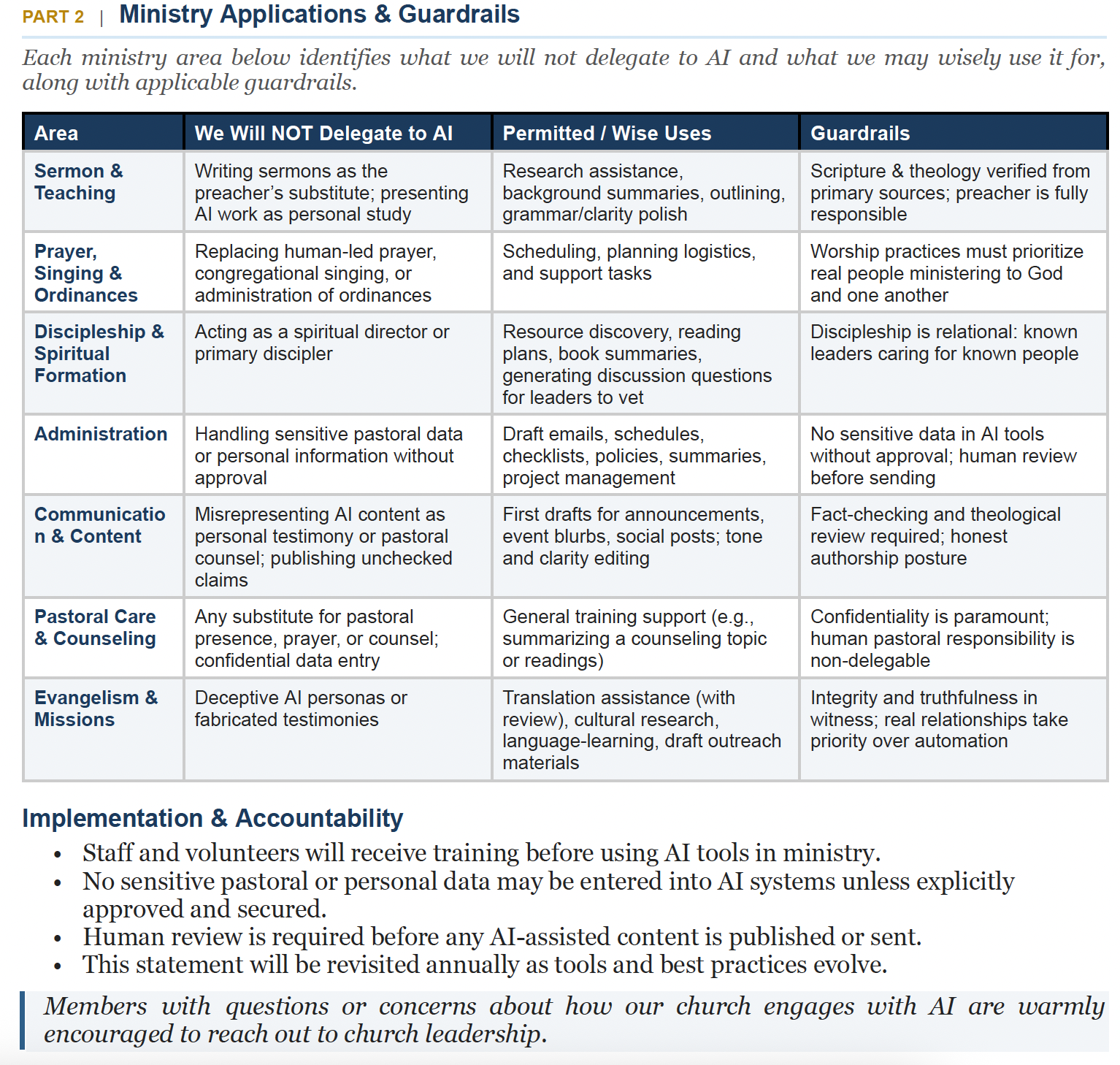
Luke Long, Walter Edwards (pseudonym), and Luke Duggar, “Church Statement on Artificial Intelligence, 2026.
Guardrails. Remember that. It is here we find freedom and prohibitions to use AI for Kingdom purposes.
I would rather have such guardrails than discard the automobile for the horse any day. Tire rotations are easier than changing horseshoes.